Why Simulations Work: The Evidence for Interactive Physics Education
A student can recite perfectly and still be certain that a heavier ball falls faster, or that a ball fired horizontally lands later than one simply dropped beside it. The central objects of physics — forces, fields, momentum, wavefronts — cannot be seen. Traditional instruction asks students to trust an equation before they have ever watched the phenomenon it describes, so their everyday misconceptions are never really challenged. When researchers built the Force Concept Inventory to measure this directly, they found that conventional courses left most students' gut intuitions almost untouched, whatever their exam marks suggested [1].
The question education researchers have spent thirty years answering is a simple one: what actually changes those intuitions?
What the research shows
Interactive engagement roughly doubles conceptual gains
In 1998, Richard Hake published a survey of 6,542 students across 62 introductory mechanics courses, comparing how much they learned using a measure called the normalized gain, — the fraction of the achievable improvement a class actually captures between a pre-test and a post-test:
Courses that used "interactive-engagement" methods averaged a gain of about 0.48 — more than double the 0.23 typical of traditional lecturing [2].
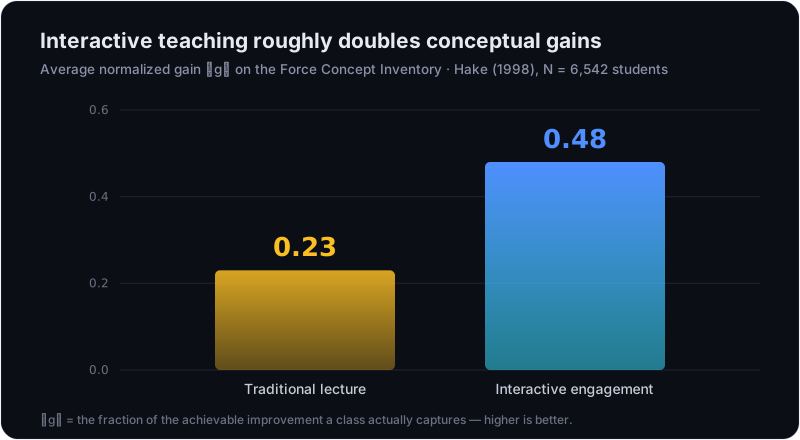
The gap is not subtle, and it held across institutions from high schools to universities. Simply telling students the physics, however clearly, produced roughly half the understanding of engaging them with it.
Active learning lowers failure and raises grades
In 2014, Scott Freeman and colleagues combined 225 studies across science, engineering and mathematics into a single meta-analysis. Two numbers stood out. Average exam scores rose by just under half a standard deviation under active learning. And the failure rate fell from 34% under traditional lecturing to 22% [3].
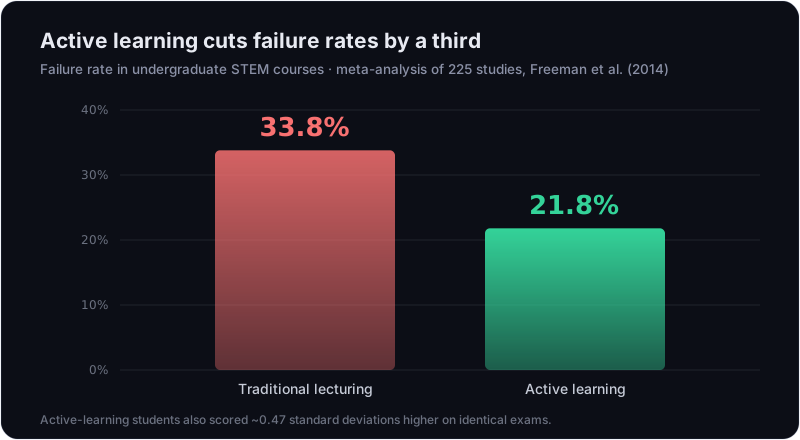
The effect was large enough that, in an accompanying commentary, the physicist and Nobel laureate Carl Wieman observed that if these had been the results of a medical trial, it might have been stopped early so that the control group could be given the better treatment too [4].
The evidence is now overwhelming that passive lecturing is the least effective way to teach — and that getting students to do physics, rather than watch it, is the single biggest lever we have.
Why simulations, specifically
None of this proves that a computer is the answer — a well-run discussion or a hands-on lab creates active engagement too. But a good simulation is a uniquely practical way to bring that engagement to every student, every day, and it does four things a static page simply cannot.
It makes the invisible visible — four ways at once
Expert physicists move fluidly between an equation, a graph, a mental picture of the motion, and the numbers. Novices experience these as four unrelated things. A good simulation shows them together and links them: drag the object and the graph redraws, the animation replays and the readouts update in real time.
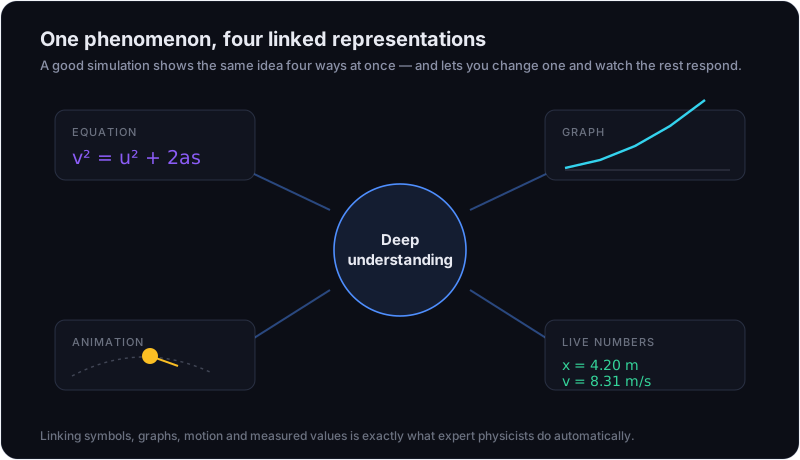
Presenting information through more than one channel at once is among the most robust findings in the science of learning, and connecting multiple representations is precisely the skill that separates experts from beginners [5, 7].
It answers "what if?" in milliseconds
Change the mass, the angle, the focal length — and see the consequence instantly. This tight loop between action and feedback is what turns passive watching into genuine inquiry. Students stop asking the screen for the answer and start asking it questions.
It lets students fail safely and for free
A student can short a circuit, crash a satellite into a planet, or drive a pendulum into chaos with no risk, no breakage and no lab budget. Remarkably, this is not a poor substitute for real apparatus: in a controlled study, students who learned circuits with a simulation outperformed peers who used real components — both on conceptual understanding and on later handling of the real equipment [6].
It puts the concept before the computation
The PhET project at the University of Colorado, founded by Wieman, built its simulations around one principle: let students build physical intuition first, so that the mathematics later has something concrete to describe. Their simulations have now been run billions of times, precisely because that ordering works [8].
Not every simulation earns these results
The research also carries a warning. Reviews of the field are clear that simulations help when they are used well — when students interact with them and construct explanations, not when they passively watch an animation play [9, 10]. A framework known as ICAP captures the ordering neatly: interactive beats constructive beats active beats passive [11].
That is the bar we hold every axiom experiment to:
Real integrators, not faked motion. Live conservation-law graphs that would visibly break if the physics were wrong. Every quantity readable as a number and every equation shown in proper notation — so that what a student sees, measures and calculates always agree.
Built for the Indian classroom, and for NEP 2020
The National Education Policy 2020 calls explicitly for experiential, inquiry-based and technology-enabled learning, and for making quality science education equitable across schools [12]. A simulation that runs in any browser answers that call directly: one laptop and a projector bring a fully-equipped, always-working physics lab to a classroom that may never afford the glassware — and the very same link works on a student's phone at home.
The takeaway
For most of a century we taught physics by describing it. The data now say, clearly and repeatedly, that students learn far more by doing it. Interactive simulations are simply the most scalable way yet found to let every student do exactly that — to change something, watch the universe respond, and finally see the idea the equation was about all along.
References
- Hestenes, D., Wells, M., & Swackhamer, G. (1992). Force Concept Inventory. The Physics Teacher, 30(3), 141–158. doi:10.1119/1.2343497
- Hake, R. R. (1998). Interactive-engagement versus traditional methods: A six-thousand-student survey of mechanics test data for introductory physics courses. American Journal of Physics, 66(1), 64–74. doi:10.1119/1.18809
- Freeman, S., Eddy, S. L., McDonough, M., Smith, M. K., Okoroafor, N., Jordt, H., & Wenderoth, M. P. (2014). Active learning increases student performance in science, engineering, and mathematics. PNAS, 111(23), 8410–8415. doi:10.1073/pnas.1319030111
- Wieman, C. E. (2014). Large-scale comparison of science teaching methods sends clear message. PNAS, 111(23), 8319–8320. doi:10.1073/pnas.1407304111
- Mayer, R. E. (2009). Multimedia Learning (2nd ed.). Cambridge University Press.
- Finkelstein, N. D., Adams, W. K., Keller, C. J., Kohl, P. B., Perkins, K. K., Podolefsky, N. S., Reid, S., & LeMaster, R. (2005). When learning about the real world is better done virtually. Physical Review Special Topics — Physics Education Research, 1(1), 010103. doi:10.1103/PhysRevSTPER.1.010103
- de Jong, T., Linn, M. C., & Zacharia, Z. C. (2013). Physical and virtual laboratories in science and engineering education.